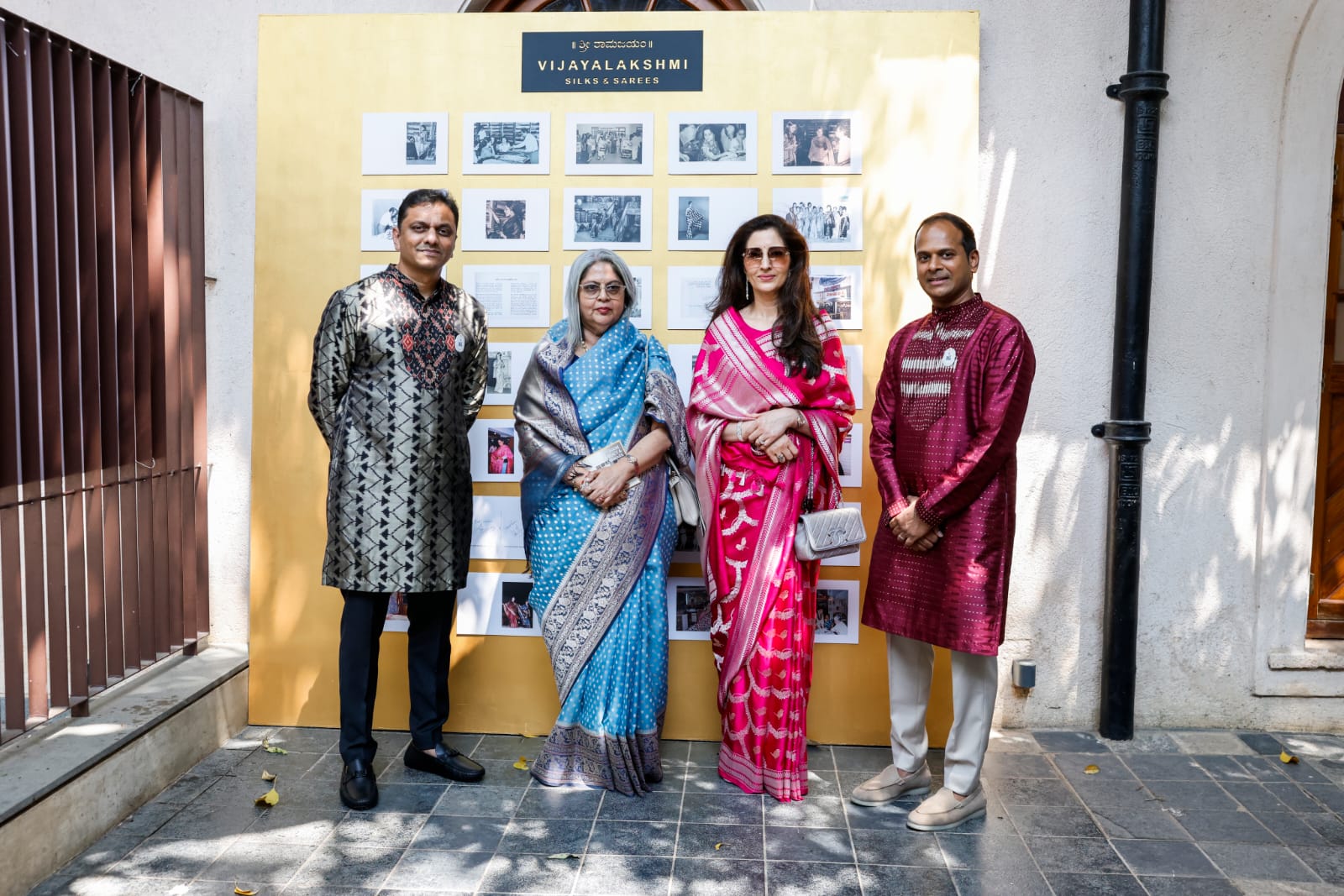
Bengaluru, April 2026: Marking an extraordinary milestone of 105 years, Vijayalakshmi Silks, a revered name in South India’s textile heritage known for its legacy of craftsmanship and timeless silk weaves, presents Loom, Legacy & Landmark—a landmark exhibition that unfolds as a historical retrospective, tracing how South India has bought, worn, preserved, and passed on silk across generations.
Hosted at Sabha, Bengaluru on 23rd & 24th April’26 (open for all), with the inauguration held on 21st April by Maharajkumari Kamakshi Devi Wodeyar and Princess Darshika Kumari, the exhibition moves beyond a conventional showcase of sarees to position textiles as living records of cultural, social, and commercial history. Conceived as a narrative-led experience, it reflects on Vijayalakshmi Silks as a living archive—a fourth-generation, family-run institution that has evolved alongside Bengaluru itself, from the old ‘pete’ marketplaces to today’s dynamic, multi-city retail landscape.
At its core lies a compelling proposition: Indian retail history can be read through textiles. Every saree embodies two parallel lineages—the craft lineage of the loom and the social lineage of the store. Within the showroom, silk becomes a civic language—chosen for rites of passage, weddings, religious calendars, political milestones, and public life—transforming each drape into a marker of memory and identity.
“This centenary narrative is further enriched by a historic collaboration with the Mysore Royal Family, bringing together two enduring legacies of craftsmanship and patronage. Drawing from exclusive access to royal heirloom sarees, Vijayalakshmi Silks presents the 105 Royal Edit—a contemporary collection inspired by these archival pieces, bridging past and present while re-centring living craft within modern desire”, says Dhiren C Ashok, Managing Partner for Production & Expansion, Vijayalakshmi Silks.
Featuring curated presentations including collections by Maharajkumari Kamakshi Devi Wodeyar and Princess Darshika Kumari, the exhibition brings together archival depth, royal patronage, and contemporary interpretation.
The exhibition also situates this story within the wider ecology of South Indian silk—spanning Karnataka’s sericulture traditions, the royal weaving legacy shaped under Nalvadi Krishnaraja Wodeyar, and the temple-town mastery of Kanchipuram. Together, these interwoven histories define what we recognise today as ‘heritage silk’.
Curated with a strong research-led approach Loom, Legacy & Landmark also marks a significant moment as one of the first exhibitions to formally document the evolution of retail within India’s textile sector. Conceived as a historical retrospective—not simply a showcase of sarees, but a story of how South India bought, wore, preserved, and passed on silk across a century. The exhibition celebrates 105 years of Vijayalakshmi Silks as a living archive: a continuous family-run textile (fourth generations) institution that has grown alongside Bengaluru itself, from the old ‘pete’ marketplaces to today’s modern, multi-city retail landscape.
“At its heart, this show offers a simple proposition: Indian retail history can be read through textiles. Every saree carries two parallel lineages—the craft lineage of the loom, and the social lineage of the store. In the showroom, silk becomes a civic language chosen for rites of passage, political milestones, religious calendars, weddings, and public life. The exhibition invites visitors to see a saree not only as an object of beauty, but as a record of taste, commerce, and cultural continuity”, adds Rohith C Ramesh, Managing Partner for Customer & Product Development, Vijayalakshmi Silks,
Visitors should leave with three things:
(1) a clear, sensorial understanding of silk—its weight, structure, sheen, and labour through the last 105 years ;
(2) a feeling of pride in Bengaluru’s cultural and commercial history, told through one family’s entrepreneurial stewardship; and
(3) a deeper respect for the technical intelligence embedded in South Indian weaving—where design is not printed on cloth, but engineered through it.
This exhibition is NOT a curatorial display but a factual historical retrospective of one of India’s oldest brands (105 years) journey through the evolution and creation of our textile retail landscape as we know and recognize today.
Above all, Loom, Legacy & Landmark is an exhibition about belonging: to a city, to a craft, and to a lineage of women and men who have kept silk meaningful, season after season, generation after generation.
Exhibition Details:
- Showcase: Loom, Legacy & Landmark
- Dates: 23rd & 24th April 2026
- Time: 11:00 AM – 9:00 PM
- Venue: Sabha, Kamraj Road.
- Entry: Open to all | No Entry Fee
More Curatorial Details : Core research pillars
- PLACE (Bengaluru as marketplace): Chickpet and the ‘petes’ as historic textile hubs; the emergence of M.G. Road / high-street retail; how neighborhoods shaped retail behavior. Intrinsic nuances and areas of collation between the south and north of India in developingtextiles and their identity for a new nation.
- MATERIAL (Cocoon → Loom → Drape): Karnataka sericulture and mulberry silk; Mysore silk’s institutional history; Kanchipuram’s weaving technique and its inter-state supply chain (Karnataka silk, Surat or Benares zari).
- PEOPLE (Family, artisans, patrons): The merchant-family as curator; long-term weaver clusters and suppliers; drapers/tailors; patrons from royal households to political and cultural figures; the modern customer as collector.
- MEDIA (How retail ‘speaks’): Shopping guide ads, catalogues, store signage, packaging, invitations; the visual language of heritage (black & white / sepia archives) as a curatorial device.
- ECONOMY (How value is made): Price and purity (zari, silk marks), credit and trust, gifting and wedding systems, and how formal retail professionalised quality claims and customer experience.
Kanchipuram as Weave: Story of Exchange
No saree belongs to a single place; it gathers its making across regions. Woven in Kanchipuram with Karnataka’s silk and Surat’s zari, Kanchipuram is a collaboration of borderless piece. As Bengaluru matured, these sarees grew into ceremonial heartbeat of its everyday-landscape. Remarkably, the silk store, continually played an active role in shaping these regional textiles to be absorbed, within the ever evolving the city identity.
Mysore Crepe as Fabric : Story Of Legacy
If Kanchipuram is a network, Mysore crepe is a homecoming, where silk is shaped close to its source. Emerging in 1912 under royal patronage in Mysore, its signature high-twist yarn and fluid drape were refined through imported Swiss technology. Over time, this fabric moved beyond courtly use into public life, bridging Karnataka’s sericulture with Bengaluru’s retail spaces-where it came to embody both regional pride and everyday elegance.
About Vijaylakshmi Silks, Bengaluru : If the silk store in Bengaluru became a salon, certain spaces came to define it. Among them, Vijayalakshmi Silks stands as a lasting institution. Founded in 1920 as Sree Vijayalakshmi Hall in Chickpet by Devatha Adappa Venkata Ratnam Setty, it emerged within the city’s historic pete markets, where textiles carried trust, knowledge, and social meaning.
Closely tied to the silk economy of the erstwhile Mysore State, the store brought together silk from Ramanagara, Mysore, and Kanchipuram into a shared urban experience. Vijayalakshmi became a vital interface between production and public life, grounded in a philosophy that regarded silk as both material and cultural inheritance.
By the mid-twentieth century, with support from figures such as Tubugere Nanjappa and the State Bank of Mysore, it evolved into a modern showroom where textiles were displayed, discussed, and chosen with care. As Bengaluru expanded, the store moved beyond Chickpet to M.G. Road and K.G. Road, bringing together traditions such as Kanchipuram, Banaras, and Mysore silk. Today, under its fourth generation, the balance of continuity and change still remains, influencing how a city wear silk.